Milotan contact lenses
The People UpstairsMilotan contact lenses are part of the Greenes’ elaborate biological disguise and one of the practical technologies that allow Milotan agents to pass as ordinary people on Earth. They conceal the unnatural appearance of Milotan eyes, but their usefulness depends on constant maintenance, fitting, and concealment. The lenses therefore do more than alter vision or appearance: they help produce the socially acceptable identity on which the family’s safety, employment, and mission depend.
Appearance and Function
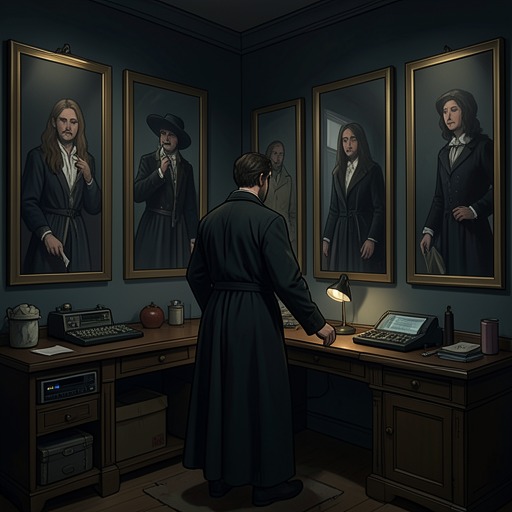
The lenses are used together with a plastomask to transform a Milotan face into an apparently human one. When May Greene returns from New York after visiting Dr. Robinson, she removes the silk-thin plastomask from her face and slips off the contact lenses, revealing that her public appearance has been assembled through removable technologies rather than ordinary human biology. The procedure exposes the disguise as a daily physical practice, one that must be put on and taken off with care.
The lenses are especially important because the Greenes’ bodies are not naturally compatible with Earth society. Dan Greene’s skin is a dull light green and his pupils are a restrained maroon red; his hands are built to support more than five fingers, leaving him caught between the wrong color for Earth and the wrong number of fingers for Milotis. The contact lenses help suppress at least part of this visible difference, allowing the agents to preserve the inconspicuous, middle-class appearance required by their work.
Fitting Terence Greene
After Terence Greene’s birth on Earth, Dr. Robinson fitted the baby with small masks and lenses in a laboratory unusually complete for a New Jersey general practitioner. Because Milotan children mature more slowly than terrestrial children, the disguises could be used during his extended period of physical development, although they remained expensive and placed a serious burden on the family’s finances. The lenses were thus involved from the beginning in the decision to raise Terence as an Earth child, while also making that decision materially costly.
The equipment did not simply conceal a temporary secret. Dr. Robinson altered Terence so extensively that he could do little except follow his parents’ path as a secret agent if the government of Milotis rejected him. The lenses belonged to a larger process in which medical intervention, artificial coverings, and the child’s altered body were combined to make an alien life possible within human institutions. His disguise was consequently both protection and confinement: it enabled school attendance and social contact, but tied his future to the success of the concealment.
School and the Failure of Concealment
When Terence Greene entered private day school at six, May Greene relied on the family’s claim that they were Christian Scientists to prevent medical examinations. The school arrangement depended on keeping the lenses and the rest of his disguise from official scrutiny. Terence was taught that other children did not wear face masks or lenses, and his question about whether the teachers wore them shows that he was already trying to understand the boundary between his family’s hidden practices and the visible normality of the people around him.
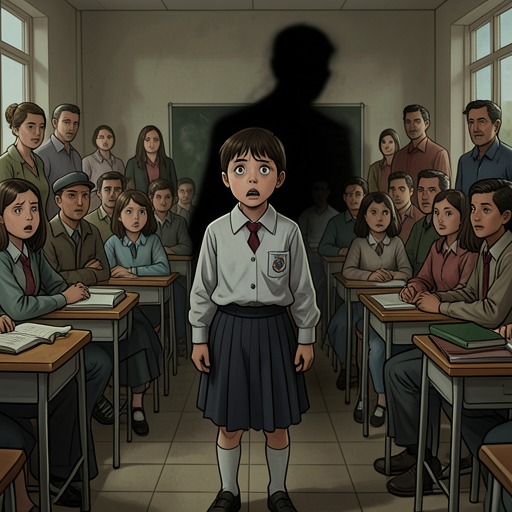
The lenses become conspicuous when the concealment fails. During a swimming lesson, Terence faced the prospect of being seen without the protection of his ordinary school appearance. The lesson exposed the difference between the school’s apparently genteel environment and the physical demands of human social life: the disguise could function in classrooms and examinations only so long as the body beneath it remained covered. Terence’s declaration that he was different turns the lenses from a successful instrument of invisibility into evidence of the secret his parents had withheld.
After the incident, Terence sat crumpled in the anteroom of the principal’s office, his contact lenses opaque with tears. Their physical condition registers his emotional collapse while also preventing him from seeing clearly. The lenses no longer provide transparent access to the human world; clouded by crying, they become visible objects and a sign that the apparatus of passing has reached its limit. May Greene can no longer treat the disguise as an uncomplicated safeguard, because the child wearing it now understands that it marks him as alien.
Cost, Dependence, and Significance
The lenses are repeatedly associated with dependence on Dr. Robinson, money, and institutional discretion. The Greenes consider obtaining masks in different sizes as Terence grows, but they know that the expense will be difficult to bear and that medical examinations or compulsory schooling could expose any weakness in the system. The lenses therefore extend the family’s options without removing their vulnerability; every stage of Terence’s growth requires new adjustments and renewed secrecy.
Their final significance lies in the contradiction they embody. They make an alien body legible as human, yet they cannot make that body human or erase the social consequences of difference. The lenses help Terence obtain an ordinary childhood, but the swimming lesson reveals that ordinary life has been structured around conditions his body cannot safely meet. When May later pats the plastoskin covering his small, mutilated hand and prepares to report him to Milotis, the lenses belong to the same system of concealment that has protected him and isolated him. They are a precise emblem of the family’s existence on Earth: technically effective, financially burdensome, emotionally costly, and always vulnerable to the moment when the hidden body must appear.